Facing the Wall: Why Some Ballet Studios Are Covering Their Mirrors (And What It Means for Your Kid)
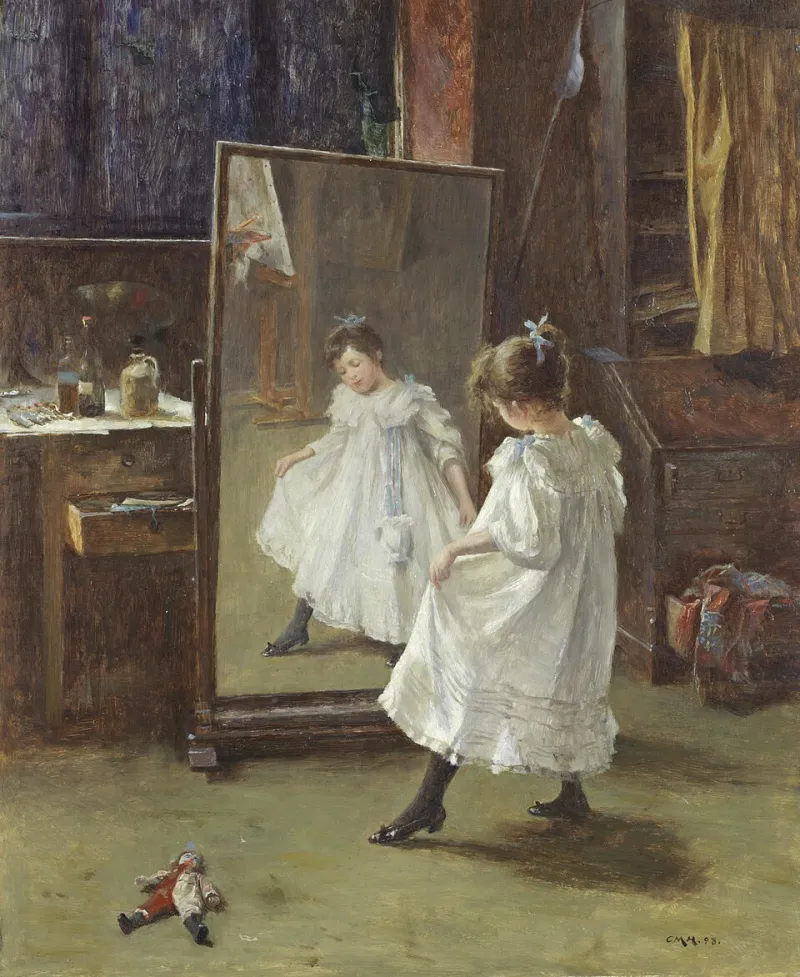
Photo: Charles Martin Hardie, Public domain, via Wikimedia Commons
Picture a ballet studio and your brain fills in the details automatically: sprung floor, barre along the wall, and a wall of mirrors reflecting a room full of leotards. That mirror is so iconic it's practically shorthand for the art form itself.
So it might surprise you to learn that some studios across the country — from Seattle to Austin to right here in our own community — are covering them up. Not renovating. Not waiting for new glass to arrive. Deliberately hiding them.
It's not a gimmick. It's a debate that's been simmering in dance education for years, and it's worth understanding before you sign your child up anywhere.
A Century of Checking Your Work
Mirrors entered ballet training for a simple reason: dancers can't see themselves. A tennis player gets instant feedback when a ball lands out of bounds. A pianist hears every wrong note. A dancer executing a pirouette has to feel whether her hips are square — or rely on a mirror to show her.
When mirrors became standard in American studios in the early twentieth century, they solved a real problem. Teachers could demonstrate a shape and twenty students could compare their own reflection to it, all at once, in real time. Corrections that once required hands-on adjustment became visual and immediate.
For technique-heavy training, that's genuinely powerful. Ballet is, in part, a science of angles: the turnout from the hip, the line of the leg, the placement of the arm. The mirror is an honest teacher. It doesn't flatter, and it doesn't let you fake it.
The Case Against the Glass
But mirrors have a shadow side, and anyone who's watched a twelve-year-old pick apart her reflection mid-plié knows it.
Dance educators and sports psychologists have increasingly flagged a few concerns. First, mirror-checking can pull attention outward. Instead of feeling where her weight is, a student becomes glued to her image — and the image becomes the class. Second, for some kids, the mirror turns into a critic. Body image researchers have noted that environments built around constant self-observation can feed self-consciousness right at the ages when it's most fragile.
The third issue is more subtle: some skills don't transfer well from the mirror to the stage. A dancer who's learned to balance by watching a fixed point in the glass can wobble badly when that reference point disappears under stage lights.
Enter the mirrorless movement. Some studios cover their mirrors for specific exercises — an adagio here, a traveling combination there — so students learn to trust proprioception, the body's internal GPS. Others go further, keeping glass covered for entire beginner sessions, especially for young children.
So Which Builds Confidence Faster?
Honest answer: it depends on the kid, and the studios doing this well tend to agree.
Mirrorless work tends to shine for younger dancers and anxious beginners. Without a reflection to judge, kids often move bigger and worry less. Teachers compensate with tactile corrections — a gentle hand squaring shoulders — and imagery: "grow taller like a sunflower," "float the arms like seawater." The feedback loop moves from eyes to body.
Mirrors, meanwhile, remain hard to beat for older students refining advanced technique, and for anyone preparing for auditions, where precision matters and video review is standard.
The most thoughtful studios we know don't choose. They treat the mirror as one tool in the drawer — sometimes covered, sometimes not — and they can tell you exactly why on any given day.
What Parents Should Look For
You don't need a dance background to evaluate this. On your next studio visit, ask three questions:
- Is the mirror a teaching tool or a crutch? Listen to how the instructor corrects. If every note is "look at the mirror and fix it," that's a thin answer. If corrections mix visual, tactile, and imagery-based cues, you're in good hands.
- Do they ever cover the glass? Even if a studio loves mirrors, a teacher who occasionally drapes them shows they're thinking about body awareness, not just appearances.
- How do students talk about their bodies? This one you observe, not ask. A healthy studio culture shows up in how kids treat each other — and themselves — in front of that glass.
The Bottom Line
The mirror isn't the villain of ballet training, and it isn't going anywhere. But the studios questioning it are asking a fair question: should a child learn to dance by watching herself, or by feeling herself?
The best answer, for most students, is both — sequenced thoughtfully, by teachers who know why they're doing what they're doing. Ask the question at your next trial class. A good studio will light up. A great one will show you the curtain they pull across the wall.